
Project Management Tools: what can software replace and what can’t it? Interim management is an innovative way of dealing with temporary shortage of middle and senior managers within the company.

Project Management Tools: what can software replace and what can’t it?
The manager of an overdue project signs a new software licence agreement, convinced that the chaos will sort itself out within a few weeks. It doesn’t. Research by the Project Management Institute (PMI) shows that teams operating with a formal framework succeed on 72% of their projects, compared to 61% for those without one. The difference comes down to team discipline, software can help, but only up to a point.
Meanwhile, the Digital.ai 17th State of Agile report shows the proportion of respondents satisfied with agile practice fell from 71% to 59% between 2022 and 2023. A single survey doesn’t make a trend, of course, but it does serve as a useful warning: widespread use of agile methodology doesn’t automatically translate into satisfaction. It’s worth taking a clear-headed look at what project management tools can actually do today, and what a business leader should consider before committing to any of them.
Six types of project management tool
By function, project management tools fall into six categories:
Simple task managers work with lists and cards, suited to small operational teams where there are no complex dependencies.
Gantt-based schedulers follow the waterfall model. They handle work breakdown structures, critical paths and variance against baseline plans, which is why they’re favoured in construction, manufacturing and engineering projects. (The critical path is the longest sequence of interdependent tasks in a project. It determines the earliest possible completion date. If any task on that path slips, the overall deadline slips too. Other tasks have float, so a day or two’s delay there doesn’t necessarily matter.)
Agile and Kanban platforms think in terms of iterations, product backlogs and work-in-progress limits.
Portfolio and resource management systems help senior leadership and project management offices (PMOs) decide which initiatives receive people and budget.
Knowledge base platforms rescue decision logs and specifications from the depths of email chains.
Unified work management platforms bring every view into a single interface. They’re flexible, but cannot replace dedicated Gantt-based schedulers.
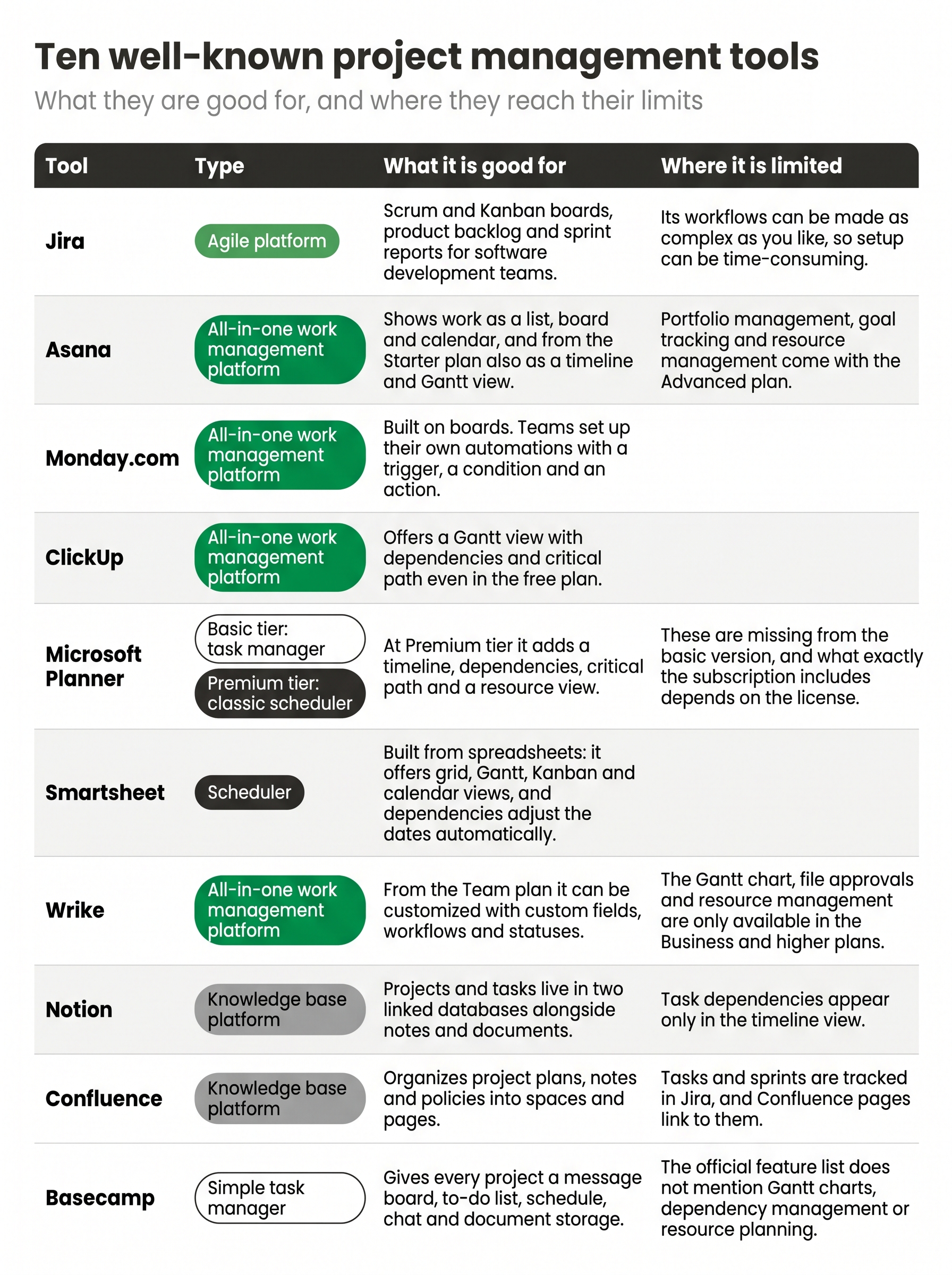
Ten Well-Known Names
The six categories above describe types. The names below are specific software products, each of which fits into one of those categories.
Jira, Confluence and Microsoft Planner are available with a Hungarian-language interface. Monday.com, Wrike, Notion and ClickUp do not list Hungarian among their official supported languages.
Six criteria to consider before signing
The first is team size. For fewer than ten people, ClickUp or Trello delivers quick visibility; for several hundred, loosely structured systems produce data chaos — you’ll need permission levels and portfolio reporting. The second is methodology: if client contracts specify fixed deadlines and scope, a purely Scrum-based tool will let you down. The third is integration with Teams, Slack, SAP or SharePoint. The fourth is total cost of ownership: on top of the licence fee, add implementation costs, training time, unused licence tiers and AI feature surcharges. The fifth is data protection: European data storage, GDPR compliance, ISO/IEC 27001 certification. The sixth is language — a colleague on the shop floor can easily be put off by an English-only interface.
Software actively causes harm in three situations:
Over-configuration: too many mandatory fields and approval checkpoints lead colleagues to close tasks with fictitious data.
Excessive administration: it diverts attention from value-creating work.
Low adoption: work retreats into emails and private spreadsheets, and the dashboard loses touch with reality.
AI: Reality and Promise
Gartner predicted in 2019 that by 2030, AI would take over 80% of today’s project management work. That remains a forecast, there are no measured results to back it up yet.
Today, AI appears to save genuine time in three areas:
compiling status reports,
turning meeting recordings into tasks with owners and deadlines,
and searching organisational documentation.
Risk-flagging algorithms, however, only work from recorded data. They can’t see internal politics, a key person burning out, or a decision that’s being quietly shelved. Automatic rescheduling without human oversight destabilises workloads.
Project management tools and interim management serve the same purpose: making visible, quickly, what is actually happening inside an organisation. In both cases, the most valuable capability is impartial diagnosis, deciding how much of what the dashboard shows is actually worth believing.
Interim Ltd works with experienced project leaders and interim managers who can find their feet in an existing tooling environment within days and make the necessary corrections.
FAQ
Which project management tool is worth choosing?
The decision should be based on six criteria: team size, methodology, integration with other systems, total cost of ownership, data protection, and the language of the interface. The licence fee is only part of the cost, implementation, training time, unused licence tiers and AI feature surcharges all add up.
What types of project management tools are there?
The market divides into six groups: simple task managers, Gantt-based schedulers, agile and Kanban platforms, portfolio and resource management systems, knowledge base platforms, and unified work management platforms. Simple task managers are suited to small operational teams; Gantt-based schedulers are favoured in construction, manufacturing and engineering.
Is a new piece of software enough to rescue an overdue project?
Generally not. According to PMI research, teams with a formal framework succeed on 72% of their projects, compared to 61% for those without one. The difference comes from disciplined working practices, software helps with that, but only so far. Rescuing an overdue project therefore starts with fixing how the work is being run.
When does project management software actually harm a team?
In three situations. Over-configuration: too many mandatory fields and approval checkpoints lead colleagues to close tasks with fictitious data. Excessive administration: it diverts attention from value-creating work. Low adoption: work moves into emails and private spreadsheets, and the dashboard loses touch with reality.
What is AI actually useful for in project management tools today?
Today it delivers genuine time savings in three areas: compiling status reports, turning meeting recordings into tasks with owners and deadlines, and searching organisational documentation. Risk-flagging algorithms only work from recorded data, which means they can’t see internal politics or a key person burning out.